Krishi Sakhi is an AI-powered smart agriculture companion that delivers farm-specific advisories using integrated national datasets such as ISRO Bhuvan satellite imagery, Indian Meteorological Department weather data, ISRIC SoilGrids soil intelligence, and Central Ground Water Board groundwater insights.
Built around voice-first interaction, land profiling, activity tracking, and AI-driven query processing, the platform transforms fragmented agricultural information into a personalized digital farming ecosystem focused on accessibility, regional relevance, and data-backed decision support.
The Problem
Farmers often rely on fragmented and inconsistent sources for critical information such as weather forecasts, pest alerts, soil data, and government schemes. Many existing solutions require continuous internet connectivity and advanced digital literacy, making them impractical for rural users.
This leads to:
- Missed irrigation or fertilizer timings
- Limited awareness of pest outbreaks
- Generic advisories instead of farm-specific guidance
- Low adoption of digital agriculture tools
The challenge was to design a single, intuitive platform that works even with limited connectivity and minimal technical knowledge.
The Solution
Krishi Sakhi was conceptualized as a digital farming companion that blends AI-style conversation, land profiling, reminders, and activity logging into one unified mobile application.
Instead of overwhelming farmers with data, the app focuses on:
- Voice Interaction over Typing
- Local Storage over Constant Internet
- Personalized Insights over Generic Tips
The experience supports both English and Malayalam, ensuring inclusivity and ease of adoption.
Core Features
Land Profiling
Farmers can create a digital identity for their farm by selecting soil type, water availability, pest risks, and weather patterns. Even when real map APIs are unavailable, mock coordinates and radius estimation maintain functionality.
Activity Journal
A structured logging system allows tracking of sowing, irrigation, spraying, pest control, harvest, and custom activities. Photo capture and simulated voice notes help maintain richer farm records.
Conversational Assistant
An AI-style chatbot with local history, text-to-speech, and simulated speech-to-text allows farmers to ask questions naturally, reducing reliance on manual typing.
Notifications & Reminders
Seeded local notifications ensure farmers receive timely reminders for irrigation, fertilization, and crop management even without server connectivity.
Offline-First Architecture
All activities, chat logs, and user data are stored locally using AsyncStorage, making the application reliable in low-connectivity environments.
Bilingual Accessibility
English and Malayalam translations are integrated using react-i18next and i18n-js, enabling seamless language switching.
Technical Stack
| Category | Technology |
|---|---|
| Framework & Navigation | React Native with Expo SDK, Expo Router, TypeScript |
| Storage & Persistence | AsyncStorage (Local-First Data Handling) |
| Device & UI APIs | Expo Camera, Image Picker, Notifications, Speech, Haptics |
| Animations | React Native Gesture Handler & Reanimated |
| Internationalization | react-i18next, i18n-js |
| Tooling | ESLint, Web Export with Workbox Service Worker |
The architecture was intentionally modular to allow future cloud synchronization and AI model integrations without redesigning the entire system.
Data Sources & Intelligent Integrations
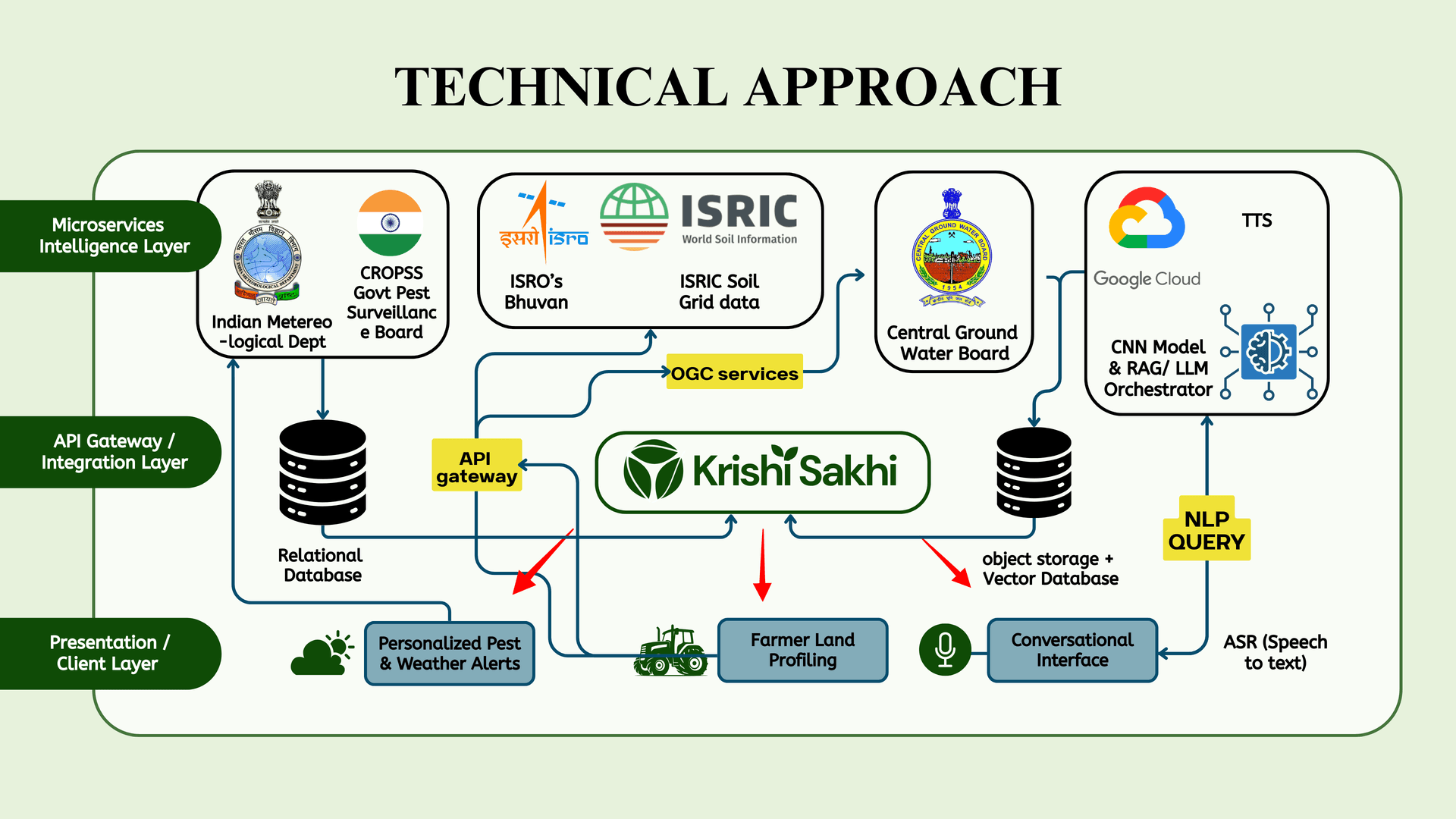
To evolve beyond a simple activity tracker into a data-driven advisory ecosystem, Krishi Sakhi’s architecture was designed around multiple national and open agricultural datasets.
Conceptual / Planned Integrations Included:
- ISRO Bhuvan – satellite-based geospatial mapping for land insights
- ISRIC SoilGrids – soil composition and fertility analysis
- Indian Meteorological Department (IMD) – real-time weather forecasting
- Central Ground Water Board (CGWB) – groundwater availability and irrigation planning
- Government Pest Surveillance Boards (CROPSS) – pest outbreak monitoring
These integrations were structured through an API Gateway and Microservices Intelligence Layer, enabling the system to generate hyper-personalized alerts instead of generic advisories.
System Architecture Overview
The architecture followed a three-layer design:
-
Presentation / Client Layer
- Mobile UI built with React Native
- Conversational interface
- Land profiling modules
- Activity tracking and dashboards
-
API Gateway / Integration Layer
- Routing, authentication, and data orchestration
- Connection to external agricultural datasets
- OGC service handling for geospatial data
-
Microservices / Intelligence Layer
- NLP query handling
- CNN models and RAG/LLM orchestration
- TTS and ASR voice pipelines
- Object storage and vector databases for knowledge retrieval
This layered structure ensured scalability, modularity, and the ability to evolve into a full AI advisory ecosystem.
Challenges Faced
Offline Reliability vs Feature Richness Maintaining smooth functionality without backend dependency required careful local seeding strategies.
Voice Accessibility Simulation Providing realistic voice-style interactions without heavy cloud reliance demanded optimization and creative design.
Localization Nuances Balancing Malayalam translation accuracy with UI readability required iterative testing.
Scalability Planning Designing for thousands of users while keeping infrastructure lightweight influenced early architectural decisions.
Impact & Vision
Krishi Sakhi aims to lower the digital barrier in agriculture by combining voice interaction, offline capability, and personalized insights. The platform encourages smarter decision-making, better record keeping, and greater awareness of sustainable farming practices.
The long-term vision includes:
- Real map and sensor data integration
- Hosted LLM endpoints for live advisories
- Backend synchronization for multi-device usage
- Government and cooperative ecosystem linkage
Key Learnings
- Offline-first design is crucial for rural technology adoption.
- Voice interfaces significantly reduce digital friction.
- Language inclusivity directly influences usability.
- Modular architecture enables long-term scalability.
- Empathy for the end user often matters more than feature count.
Closing Note
Krishi Sakhi reinforced the belief that impactful agricultural technology does not always require heavy infrastructure or constant connectivity. Thoughtful design, accessibility, and personalization can transform a simple mobile app into a trusted digital farming companion that empowers farmers to make smarter, data-driven decisions every day.